Friday, August 16, 2013

News from the Society for Organizational Learning, North America


SoL has affected many thousands of people since its founding.  It is home to many of the ideas and frameworks out of which Art of the Future draws its inspiration and aspirations. In fact, Michael and Anika met through their work together at SoL.  Structural Dynamics, our framework for thinking about the future was stressed tested through workshops, discussions and thought pieces we've done with SoL and its members.

SoL has been going through an extensive transition over the last three years as a new legal framework has been established to support its revised mission - being a network of networks for those who want to understand and influence the dynamics of organizational and societal systems.  There are now twenty two SoL entities around the world operating in a loose confederation in support of the five disciplines of systems thinking in all of their manifestations.

Michael is the co-chair of SoL, North America (SoL NA), one of the largest and most well-established of the SoL constellation.  In this capacity, he and his colleagues on the Sol NA Council and in the SoL NA Connectors Infrastructure Subcommittee have  been exploring and promoting a number of activities: 
  • The Project Incubator uses a Strategy Matrix co-created by the SoL North American Council and Peter Senge.  The Incubator is a bottom-up approach to generating projects related to
    Action at the Incubator
    SoL's mission and principles that members own and develop.  Michael has co-facilitated two of the Incubators.  The response of participants has been excellent, generating a high level of energy and enthusiasm.   Six projects were investigated and developed through the last Incubator.  There are several Project Incubators planned in the coming months.  In addition, Michael and colleagues like Carol Gorelick, Deborah Reidy, Mark Alpert and Tom Flanagan of 21st Century Agoras 
    are working on creating a version of the SoL NA Incubator that can be applied inside organizations to facilitate greater member engagement in the strategy process at all levels of responsibility.  
  • The Speaker's Bureau is an effort by SoL NA to place members (and probably some others as well) who are skilled at keynote presentations into conferences, associations,
    David Koehn
    corporate, public agency, academic and other settings.  Many people who cross paths with SoL NA, either as members, course participants, or "friends of the family" are skilled speakers with wide networks of association.  The objective of the Speaker's Bureau is to match up talent with paying opportunities to spread insight and conversation about systems thinking and organizational learning.  SoL NA is pulling together profiles of prospective speakers, which it is publishing and will be communicating to potential engagement sponsors.  David Koehn's profile is an example of what the end result looks like.  (NB:  We're still in the process of creating the Bureau; so, the contact number isn't finished at the moment.  Please contact Michael at msales@solonline.org for inquiries regarding the Speakers Bureau. 
  • As part of a larger effort for SoL NA to act as a one-stop shop for association conferences, Stephen Gianotti has taken responsibility for creating a team that will place SoL NA members as workshop leaders before and after these events.  His work has already seen some impressive results with a placement at an important organizational learning/systems thinking event.  Prasad Kaipa, a long time SoL member, will be addressing the American Society for Training and Development's Global Forum on August 21, 2013.  To learn more about these efforts, please contact Stephen direct via email at sgianotti@comcast.net.  
  • SoL NA's core courses (Foundations for Leadership, Executive Champions Workshop and Leadership for Sustainability) featuring faculty like Peter Senge, Beth Jandernoa, Robert Hanig, Otto Sharma, and Darcy Winslow (among others) continue to be extremely popular.  Most of these are sold out well in advance of the event.  SoL NA's President and CEO, Frank Schneider, takes the lead on the management of these programs.  All SoL members receive a 15% discount on these courses.  Please contact Frank directly at frank@solonline.org for further information about these SoL NA programs. 
  • Deborah Reidy is taking the lead on designing and piloting a Systems Thinking Certificate Program. Tentatively entitled “Accelerated Learning: Results in Systems Thinking” the program will build systems thinking capacity in organizational leaders in a way that is collaborative, challenging and results oriented so that critical business challenges are successfully addressed and new learning occurs.  The program is currently envisioned as a virtual program offered over a period of weeks to a cohort of participants working in the same company. It is being designed based on cutting edge research in the field of neuroleadership. Program advisors will include experts in neuroleadership for the design and systems thinking for the content.  For more information, contact Deborah at dreidy@solonline.org.      


Wednesday, August 14, 2013

Making Patient Safety a Key Hospital Priority

Making Patient Safety a Key Hospital Priority                               

Patient safety in hospitals and other healthcare delivery settings is a major public health problem. Several distinctive challenges combine to create a high-risk environment for patients that can result in grave - and costly - personal and organizational consequences. 

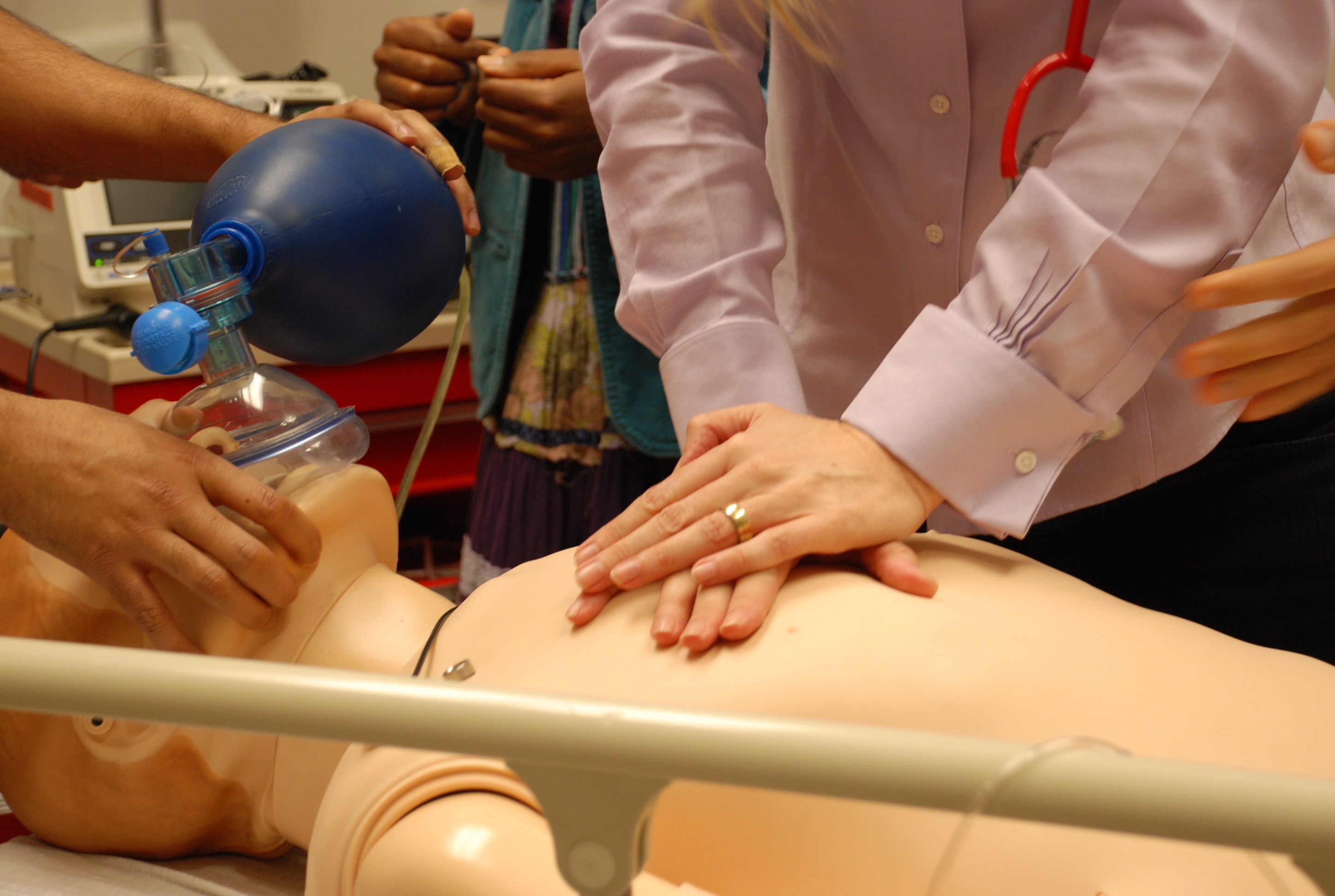
A Training Team Works on a Mannequin 
Michael and co-authors Dr. Jeffrey Cooper, Dr. Sara Singer and Jay Vogt recently published an article in Reflections Magazine discussing how defensive behaviors among hospital leaders, managers, and staff aggravate the risks to patient safety in hospitals.  Here is a link to the article, "The Journey to Patient Safety," in which we describe a multidimensional training program, Healthcare Adventures™, in which the exploration of so-called "automatic defensive routines" figures as an important focus. Healthcare Adventures combines a simulation of a traumatic patient safety event with structured reflection. Taken together, these kinds of learning opportunities support collaborative inquiry and appreciative engagement by the members of healthcare management teams around important issues such as patient safety.  (You have to scroll down into the PDF a couple of pages to come to the body of the article.)  

Michael, Jay, Jeff and Sara have been working together for a number of years in the under the auspices of the Center for Medical Simulation, a training institute based in Charlestown MA that has the support and engagement of a number of hospitals and research institutions, such as Partners Healthcare, the Massachusetts General Hospital, Brigham and Women's Hospital, MIT, and the Harvard School of Public Health.  CMS was one of the world's first healthcare simulation centers and continues to be a global leader in the field. CMS is approved by the American College of Surgeons (ACS) as a Level 1-Accredited Educational Institute, and is endorsed by the American Society of Anesthesiologists (ASA).  Jeff Cooper, the founder and executive director of CMS, is also the recipient of a number of awards for his pioneering work in the field of patient safety.    
Tom Bigda-Peyton

Healthcare Adventures is an on-going project.  Our thinking is closely aligned with Dr. Tom Bigda-Peyton, managing partner of Second Curve Systems, who focuses on the alignment of functions, technology and people throughout a hospital or other healthcare delivery organization to bring better and safer results to the patient and more positive experiences to clinical and administrative teams.  Second Curve Systems offers a paradigmatic shift in the way healthcare is delivered and in the expectations that people have of healthcare systems.  

Consider this: the recent airline crash in San Francisco in which two lives were lost constitutes the first such fatal crash in the United States since 2009.  Contrast that with the fact that something like 45,000-95,000 people die in American hospitals every year as a result of preventable safety accidents and issues.  What if hospitals were as reliable as commercial airlines?  That is the sort of high reliability outcome Second Curve is going for.  Second Curve's thinking about the overall context of healthcare combined with Healthcare Adventures capacity for build trust in hospital teams so that they can grapple with and resolve the complex issues confronting patient care looks like a potent and much-needed combination.  


Tuesday, August 13, 2013

Report from the 2013 World Future Society Annual Meeting

Report from the 2013 World Future Society Annual Meeting

It's always fascinating to attend the annual meeting of the World Future Society.  This year's convention in Chicago was no exception, although the event seemed to be less well-attended than others.  Like many other associations, the WFS' conference-based business model seems to be in trouble.  More on that later.

Regardless of my critique of  the event's energetic tone, there was much to appreciate in the people and the content of the conference.  I was able to get to only a few of the 75 or so sessions; so, there is no way to provide a full report.  (Complete audio recordings of all sessions are available through the WFS if you want them.)

Nicholas Negroponte
Nicholas Negroponte, founder of MIT's Media Lab, Wired Magazine and of the One Laptop per Child Foundation, dedicated to providing each child in the world with a means to learn and teach, was the opening keynoter.  He began with commentary about ways to consider the future:
  1. Extrapolative, i.e., prediction based on where you are, e.g., revolutions in the photographic, music, and publishing industries were all infinitely predictable based on what digital information has put in front of us.  (The same can probably be said of healthcare delivery, the transportation system and the energy infrastructure today, I should think.)  Fascinatingly, Negroponte quoted a high-ranking executive from someplace like Kodak as saying that "It was my fiduciary responsibility to deny what I knew was coming."  Now, that's what I call dedication to sunk costs!  So much for preserving shareholder value!  
  2. Orthogonal, i.e., hard to see because it's 90° different from what's going on now, e.g., self-driving cars and wirelesses.  He points out that it took Bangkok 7 years to install a wireless network while it took Bolivia only 7 days!  Nikola Tesla also speculated and demonstrated that wireless power transmission is not only possible, but increasingly probably.  (Art of the Future tried to point this out to a prospective client in the power cable business several years ago only to be summarily shown the door.)  Negroponte predicts that only 1/10th of the cars on the road will be needed in the relatively near future as self-driving cars become the norm.  It's there; it's happening; but we don't see it yet.
  3. Metaphorical, e.g., thinking of a computer as a "foreigner" in the land of the humans, an entity who doesn't know that much about communicating with us, but, with our engagement and tutoring, is rapidly learning.
  4. Contrarian, i.e., you may think things are going one way, but they ain't.  Take nuclear power.  According to Negroponte, "Nuclear power is the only one!  We need it!  We have to have it!"  Now, a lot of renewable energy people don't see it that way, but Nick thinks we're all going to have "toaster sized" nuclear power plants installed in our homes sooner than we can imagine.  (He's not alone in this way of thinking.  My friend, Dr. Leslie Dewan, Chief Science Officer and co-founder of Transatomic Power, is one of a number of brilliant young scientists looking to new ways of working with nuclear power, in this case turning nuclear waste into energy that can be used safely in consumption and commerce.)  
This overview led him to the heart of his talk, universal education.  Here's my summary of his comments:
  • The One Laptop per Child effort has demonstrated the efficacy of focusing on curiosity.  The Foundation has distributed 3 million laptops to children who have no classrooms and no teachers in places where there is virtually no literacy.  There are 100,000,000 such children in the world!  The Foundation has stuffed these laptops with a range of 500 apps in English and has engaged in rigorous longitudinal research in following up on outcomes in several villages. Within days, the kids were using 50 apps.  Within six months, they were changing the code of the apps by hacking into the system on their laptops, And --in a result I find truly phenomenal-- the research seems to demonstrate conclusively that children can learn to read (a foreign language, English) on their own!!!  Let's get those other 97,000,000 laptops distributed pronto!
  • Learning is different than education.  Learning in school is very different than the learning that takes place in the first five years of life.  Education shouldn't be in the testing business until children are something like 13.  It should be in the curiosity business, promoting and using the natural eagerness of children to know something about the world around them.


José Luis Cordeiro led a session on the work of the Singularity University, which, as the logo states, sees itself as "preparing humanity for accelerating technological change."  The Singularity is based on the view that, by 2045, computing power will be equivalent to human brain power, i.e., according to Cordeiro, "You won't know if you're talking to a person or a computer."  Immortality is one of the consequences of this.  By printing organs and swapping out stuff of ours that gets old with kidneys and lungs that never get tired, we're going to live forever!   

I have very mixed feelings about the Singularity.  One mixed feeling I have about it is that everyone associated with the project has an IQ that I can't even calculate with a digital adding machine, and that's a bit intimidating.  Another is that I heard Ray Kurzweil give a keynoter at the WFS about ten years ago in which he extolled his good health.  At the time I think he was 56. He described a regimen of something like 100 dietary supplements he took per day.  If memory serves he said his doctor told him he had the look and vitality of a 35 year old man, tops.  I looked at the guy, and turned to my friend who was watching the presentation with me and said, "This guy needs to get a new doc."  There was no way he looked like a 35 year old.  He looked like a guy who was 56.  Unfortunately, I was righter than I wanted to be because Kurzweil, like his father before him, suffers from a number of serious health problems, one of which almost killed him a few years ago.  
José Luis Cordeiro

Singularity U's ambition is to train up a bunch of really, really smart young people who are, essentially, going to take over the world (or, putting it more generously, guide the world) into the inevitable
Technotopia that folks like Cordeiro so fully embrace.  

The Technotopia is accelerating along four interrelated and increasingly integrated vectors:
  1. Nanotech, which among other things, will eliminate pollution.  There will be nothing extra and there will be no waste.  "Waste is raw material in the wrong place." Nanotech will make sure that  every atoms will be placed in exactly the right spot.  (My mother would have been happy about this.)  Cloning will be old hat in a world where you can constantly "improve" yourself.  "A number of Indian gods have three heads; so, cloning a new head is not a problem in India." (Said in a jocular fashion, but I don't think he was kidding.)
  2. Synthetic biology, using the 3 gigabytes of data in the human gene to greater and greater advantage.  By today's terabyte standard, that is no longer a big deal to map.  In fact, some people would probably call that a chump digital change.  You can now get a DNA map for about $100, for example.   
  3. Info technology is leaping ahead like a grasshopper on a mission.  Watson, the IBM computer that wins in chess and Jeopardy, "was born with Wikipedia in its head."  What this kind of computing power will mean for the future of human/robotic interaction is something almost no one is prepared for, but everyone needs to get ready for.  (Personally, I'm looking forward to highly advanced expert systems.  I have about twenty-five ideas every day, and nothing would make me happier than having a crew of robots who could actually execute on these things.  I could get a lot more blog entries done if I were editing them instead of having to write 'em!)
  4. Cognotech, i.e., really understanding how the brain works and using technological advances, such as brain implants, to get it to do things that we can't get it to do now, e.g., sleep better and beat Alzheimer's.  "Talking is primitive....We're on the verge of something similar to telepathy." 
It all sounds pretty wowwy-zowwy to me, and I like a lot of it.  But, I also found something sort of sinister in the language of the presentation.  There were a lot of comments about all of the "Amish" around the world, who aren't going to be able to keep up with or adapt to the changing technological context.  They are going to be "left behind".  It gave me the feeling of being in a bad Tim LeHaye novel.  And then there were the repeated references to the praise heaped upon Singularity U by Larry Page, one of Google's founders, who is also a key player at the University.  If I heard him correctly, Cordiero quoted Page (a Stanford faculty member) as saying that Stanford is "shit" in comparison to Singularity U.  I don't know why he felt it necessary to use that sort of language in this setting.  It was unnerving, not because Stanford is above criticism or because Singularity U isn't as great as people say it is, but it just seemed sort of small minded for someone who is going to "preparing humanity for accelerating technological change."  

There was something very non-empathetic in Cordiero's attitude toward the technologically unenlightened, whoever they may be.  Mitt Romney had a problem with "the 47%"; Cordeiro sounds like he might have a problem with "the 97%".  Utopians and Dystopians of all sorts seem to have a challenge with the messiness and unpredictability of living systems and humanity.  Something to think about before becoming a full-fledged Singularitan.

On the other hand, the session ended with a statement that I agree with:  "We have to be optimistic about the future.  We are intelligent enough to survive and thrive.  We have got to move beyond our tiny planet."

Fabienne Goux-Boudiment
Using the exciting presentation technology, Prezi, Fabrienne Goux-Boudiment led a fascinating and important discussion of The Futureplex Mindset or Futuring in the Year 2100.

Fabienne describes a stark difference between the World 1.0 -- characterized by a focus on matters such as individualism, effectiveness and efficiency-- and the World 2.0, which is concerned with the "more feminine values" of synthesis, horizontal rather than vertical knowledge, cooperation, and lateral thinking.  "The signs of the new world are all around us; we just have to get past the World 1.99999999," where we have been hanging out for the last few decades.

While her commentary on artificial intelligence, robotics, and physical enhancement of humans in the future were enlightening, the emergence of a quantum perspective on time was the most important insight I took from a talk that filled with provocative information and ideas.  Futuring in 2100 will entail a movement past causality and linearity.  The nature of time is subject to change as we arrive at ever-more challenging perceptions of our universe, e.g., that there may be another universe in which we exist but are very different standing right next to the one we are in and separated by only the thinnest of strings of space-time.  (String theory provides only only one of a number of hypotheses regarding parallel universes.)

Futuring in the future will require a "new mental literacy", one that takes a non-linear orientation toward time, one that accepts not-knowing.

Of course, it daunting to me, someone who has never been very good at science, that most people don't understand Newtonian physics, let alone Einsteinian relativity.  So, Humanity has a lot of work to do to arrive at the point where we'll comprehend enough quantum theory by 2100 to think past time.  (Maybe The Singularitans will help!)


Janice Bryant
Janice Bryant's presentation on Trends in Agriculture was an excellent reminder of the fact that, without farmers like her, there ain't no food.  Bryant is a Special Projects manager for the Navy in the Puget Sound Ship Yard, where her strategic initiatives won the Commander's Award in 2010.  She also seems to be a military officer, but I have been unable to get confirmation on this detail of her bio.

I'm an urban boy through and through, but people like me are completely dependent on sustainable agriculturalists like Bryant.  She points out, for example, that:
  • It is virtually impossible to buy sheep feed that doesn't have antibiotics and that grass feeding is under attack
  • Rabbit is in wide supply and constitutes a completely acceptable form of protein as an alternative to beef
  • Luxury foods are making agriculture so cool that remote ranching has become a well-established trend.  (Animals in Wyoming are being served up for slaughter by executives living in the Hamptons.)  
  • Soil is becoming a commodity: "Google likes farm land for servers because it's flat and near water but not near a flood plane.  1,000 acres of highly productive valley land will be used by Google.  These valley lands are a good source of food.  This trend in agricultural land usage pushes agriculture off soil where it's easy to grow things and puts it into commercial use.  Only  genetically modified organisms grows in this sort of land.  It's unsustainable!" [paraphrase]
  • Robots are being employed increasingly in farming as fewer people want to do the work.  "The fewer people who are working in agriculture, the increasingly distant people are from their food."    

What Future Awaits Europe?  Avoiding Ambiguity!  I will be brief.  This was one of those instances in which one dearly hopes that the macrocosm doesn't imitate the microcosm.  The session brought together five high powered Europeans including Mylena Perremont (a board member of the WFS), Robert Salmon (fmr. VP, L'Oreal), Annette Nijs (Executive Director Global Initiative, China Europe Business School and fmr. Dutch Minister of Education), Carine De Meyere (social entrepreneur) and Christopher Cordey (CEO of Futurenow.com) to show attendees how the leaders of Europe "are attempting to clarify the future of this potential utopia" of a united continent.  Only one problem:  the crew showed up late, and then they couldn't get the AV to work!!!! It was sort of like watching the Keystone Cops, except most of the people running around had Ph.Ds and French accents.  It was really very, very sad, since about 40 info-seekers showed up, including me who's always been a big backer of the Union.  Better luck next time!

Patrick Tucker
Patrick Tucker is a the deputy editor of The Futurist, and he demonstrated his presentation chops in spades at a session entitled Moving Toward the Predictable Future with Big Data that laid out a stack of highly relevant information to computer-aided prediction and a range of other topics.  Here are some highlights from my notes:
  • 90% of the data created in all of human history has been created in the last two years.  There will be 44 times more digital data in 2020 than there is now.  
  • What will the world be like when much of what happens in the world can be predicted and anticipated with precision?  "Using Big Data, we will be able to predict what we'll be doing 80 weeks from now with an 80+% accuracy."  We are developing a different kind of GPS, one that maps out our own trajectory of action.
  • "What about an app that will tell you whether you will regret a purchase that you're about to make, based on what your Big Data about you can tell you about you?"  [paraphrase]
  • "The way we interact communicates how we're going to behave in interactions.  Big Data will be able to predict outcomes of an interaction within 30 seconds."
  • Big Data can predict changes in the Food Price Index.  Rapid food price inflation is a key driver of war. 
  • Self-driving cars will interact with each other and enable collaborative car sharing because the cars will be able to tell drivers if they are reliable for use or not.
  • Apps for creating Big Data about yourself include: PicTracker, Carbon Footprint, and Virtual Wallet  


In many ways, Ramona Pringle's Life Imitates Art:  Cyborg, Cinema and Future Scenarios was the
Is it Ramona or Ramonabot?!!!
high point of my experience at this years' WFS Conference. Pringle's compelling set of slides and delivery brought home the truth of her assertion that "We're in the middle of the future being created."  She set the bar for originality of thought at the conference.

Near the beginning of her talk, Canadian Broadcasting System journalist Pringle put up several images of herself as a robot, but went on to assure the audience that, "I am not a robot." I needed to remind myself of this statement several times during the talk because she was doing such a great job of weaving art and life together that I wasn't sure which we were dealing with.  I cannot tell you if the photo at right is Ramona or a mock up!

Pringle believes that the utopian world of nature, as presented in Avatar may, in fact, be exactly the sort of  world that people will be inserting themselves into digitally in the future regardless of what happens to our real natural world:  "We can save what's utopian about the real world."

As an avid fiction reader, I completely understand Pringle's view that "We understand story better than reality."  I have a friend who limits himself to one novel a year and chooses to consume a voluminous amount of social science.  But Pringle points out that there are doors in fiction that non-fiction misses:  "Dystopia creates a blue print for what to avoid.  Science fiction is less about tomorrow than it is about today."

Like a number of other futurists, Ramona is quite concerned about the intimate relationships we are going to be establishing with robots. "The human intimacy we crave has become too difficult....We will be turning to robots to deal with difficult issues, e.g., the management of the aged." Will robots become our slaves?  How will we treat them?  Will they develop rights as their capacity for information processing approaches or surpasses ours?

Pringle is not afraid of technology.  "It's neutral.  The Internet is a reflection of humanity. Don't break the mirror!  Change what the mirror sees!" [paraphrase]  Social media can galvanize humanity for good, as in the case where a paraplegic was isolated by Hurricane Sandy.  People across the United States coordinated their response to this situation and made sure that the story had a happier, if not a completely happy, ending.


If Pringle's talk was the highlight of the conference, Sheryl Connelly's closing keynote was a dud.  Connelly is Ford's corporate futurist (aka manager of Global Consumer Trends and Futuring).  Given that Ford was the only major American car company to avoid the need for a government bail out in 2009, I was excited to hear from someone in such a key strategic position in the organization.  It seemed like foresight was an important ingredient in the company's ability to stay afloat while others faced bankruptcy.

Unfortunately, what she presented was a pretty pedestrian layout of established trends such as:
Sheryl Connelly
exploding population, an aging demographic in the West, Japan and China, how the great differences between India and China will play out in automobile consumption and usage, the impact of urbanization and the cynicism toward brands.

It was her elaboration of this point that led me to leave the speech.  She extolled vision and value-driven companies, such as Patagonia, which has been giving 1% of all sales to environmental organizations since 1985.  These are the brands that consumers are continuing to believe in.  

And then she went on to talk about how great Chick-fil-A is.  Chick-fil-A is significantly influence by the Southern Baptist beliefs of its founder, S. Truett Cathy.  The company's official statement of corporate purpose says that the business exists "To glorify God by being a faithful steward of all that is entrusted to us.  To have a positive influence on all who come in contact with Chick-fil-A."  So far, so good.  No doubt, an explicitly spiritual orientation can contribute to a distinctive and positive organizational culture. It's not the only framework that does so, but it is certainly one.


However, Chick-fil-A got in some very hot water with a lot of people last year, including me, when it became clear that it has donated millions of dollars to organizations opposed to gay marriage and to homosexuality more generally.  For example, Chick-fil-A Chief operating officer Dan T. Cathy made several public statements supporting the traditional family, saying about same-sex marriage that those who "have the audacity to define what marriage is about" were "inviting God's judgment on our nation."   This may constitute values-based behavior in Sheryl Connelly's book, but not mine.  So, between praising Chick-fil-A and not having much to say on other topics, I decided that I could bring my attendance at the conference to an end.

The Connelly closing highlighted a general unease I had about this conference.  It didn't really fit together thematically.  There was no connection between Connelly's closing and Negroponte's opening, for example.  The Conference exclaimed that it would be "Exploring the Next Horizon!", but I didn't get much of a sense as to what the World Future Society thinks that horizon is going to look like.  I did learn about a variety of vectors headed in differing directions, and much of that was fascinating, as it has been every one of the last 15 years.  But, the lack of coherence made the conference feel somewhat adrift for me.   


Michael Marien

My friend, colleague and mentor, Michael Marien, publisher of Global Foresight Books and, previously, the World Future Society's Future Survey, demonstrates what such an integrated consideration of the global future might look like in his recent article, Twelve Mega-Uncertainties of the Decade Ahead" in the current edition of World Future Review.  In the terms of our book, Life Sustaining Organizations -- A Design Guide, Marien lays out twelve "critical uncertainties" upon which the future will revolve.  In Marien's formulation, these include:


  1. How much global warming, by when?
  2. Will methane eclipse carbon dioxide?
  3. How high will sea levels rise?
  4. Will we run out of essential resources?
  5. How many people in 2050?
  6. What quality of people in 2050?
  7. Will decent employment be available to all?
  8. Will inequality and plutocracy continue to increase?
  9. Will the energy transition be a clear and rapid one?
  10. Will nuclear weapons or bioweapons be our undoing?
  11. Can effective global governance and law emerge?
  12. Does the exploding world of information abundance help or hinder us?
By not organizing its inquiry around these sorts of broad themes, I'm concerned that the Society's business model, which has brought so much great information and community to a large number of period for a lone period of time, may be running out of gas. 


Wednesday, March 20, 2013

The Social Context of Automatic Defensive Routines


 Chris Arygris

Don Schön

I worked closely with Chris Argyris for eight years.  He was the chair of my doctoral dissertation committee. A large body of thought has grown up around Chris' work individually and perhaps in particular around the research and writing he did with his frequent collaborator, Don Schön.  

Bill Torbert --a brilliant student of Argyris and a powerful force in his own right--  coined the phrase "action science" to define a process through which organizations and their agents (i.e., individuals and teams) reflect on and experiment with action in some disciplined fashion.  Chris and Don elaborated the use of the idea of learning in and through action several books, notably Organizational Learning:  A Theory of Action Perspective published in 1978.  (That this book is selling used on Amazon for $65 and new for over $500 is a pretty good indication of the  quality of its information!)  

A Google search yields  well over 400 direct references to Chris, who has written personally written something like 25 books and over 100 articles.  Donald Schön was a philosopher, city planner, musician and a man of  many achievements, including --I believe-- being one of the founders of the Educational Development Corporation. He was a very lovely man, now deceased.  I would say that Chris was the tougher-minded of the two, but Don was absolutely brilliant and a joy to work with.  As bright and hardworking as I might be, I was always playing catch up to these two brilliant mentors and to a number of others who were significantly and directly influenced by Chris and Don, like Lee Bolman, Phil Mirvis, Diana Smith, Robert Putnam, and Peter Senge to name a few of the many.  The theory of action perspective and all of the work surrounding it, preceding it, flowing through it and derived from it is a huge body of thought and, in my opinion, everyone who is a serious student of organizational behavior and learning owes it to themselves to dig into it long and deep.  

As a restless intellectual sojourner, I've spent a lot of time at other conceptual sites in addition to those generated by the theory-of-action perspective.  Recently, however, I've been working on an article concerning "automatic defensive routines", which has taken me back into this territory with renewed vigor and attention.  

This is my personal, brief synthesis of some elements of the Argyris and Schön related to the kind of defensiveness that is so well learned that we are not even aware of its presence. This synopsis is not based on a careful review of the wide range of literature that has been developed on this topic.  It's just the way I am thinking about it at the moment: 


  1. Except in the case of individuals were born with grievous cognitive impairments, virtually all of us coming to the world as learning sponges.  This is readily demonstrated in our acquisition of language.  We arrive asking why and how. The capacity for learning and change maybe hindered through the course of life, but it is never be fully extinguished.
  2. Everyone is born into social contexts.  Reality is given to us. I think we can argue, looking at the panoply of cultures and values that humanity has manifested both in the past and present, that there is no specific reality that is more true or valid than another reality.  Some may be more data-based, but that doesn’t mean that they are more compelling than another which is not.  So, many argue that reality is "socially constructed.”  It is the way it is because we say so.  
  3. One of the ways in which socially constructed realities to be similar, however, is in the fact that many versions of reality a search that there is a right way and a wrong way to do things, a right and wrong set of beliefs, and a dominant set of moral principles that one should live in accordance with and to which the laws of society should be related. 
  4. This rightness and wrongness is manifested in every layer of social context from family to world government structures. It is though we are taking a constantly taking a shower in a stream of consciousness that tells us what is right and and what is wrong.  The fixity of something being right and something being wrong is one of the key characteristics of authoritarian thought and action. So, one of Argyris’ “proofs” is that all of us are exposed --to one extent or another-- to a recurring set of social institutions that systematically incline us toward low inquiry thinking and behavior.  We accept the given reality of our society and function in a relationship of some sort to its norms, beliefs and rules.  
  5. Thus, one of the key learnings we derive from our socialization is that there is right and wrong way to do things. The greater the pain of doing things “wrong" and the reward for doing things “right", the bigger the individual psychological impact of this process of social learning.  
  6. The more deeply ingrained the sense of right and wrong is in the individual, the group, the organization, the society, the more reactive and automatically defensive those "units of analysis" will be to challenges, or any conditions that they experience as stressful – as defined by the actors situationally. (In other words, a situation that is stressful for someone may be no big deal for someone else.)  Most of us are greatly overtrained when it comes to being defensive, and we do not notice the automaticity of our responses.
  7. The analytical situation is made more complex by the fact that it would be completely impossible to live a life without a well-functioning automatic response. You couldn't drive; you couldn't eat; you couldn’t take a shower without operating on automatic.  Most of the things that you do every single day are on automatic. Much of what we do does not require learning. What we know is just fine, and there's nothing ambiguous about the situation that would require us to challenge what we know.  However, this knowing-what-to-do is as not true of family life, team life, and/or organizational life. These situations are much more complex and ambiguous. But, when were under stress we frequently act as though things are much more black-and-white than they really are; or, we believe there's not enough time to investigate the full context of the situation.  (“I mean, you can’t ‘take time’ to process everything!”) So, we act out of automatic defensive routines, our learned views of the right thing or the wrong thing to do in an ambiguous and complicated situation where there is no right or wrong.  
  8. Truly becoming aware of and discarding automatic defensive routines is a formidable challenge.  There are a variety of methodologies that focus on the unlearning of automatic defense routines and the practicing how to put learning oriented values into action. The so-called left-hand column personal case is an example of such method.  
  9. The objective of these methods, and of a variety of other organization and leadership development technologies, is to reveal and soften the impact of automatic defensive routines.  Some of these approaches are explicit in their aspiration to loosen the rigidity of automatic defensive routines; others are incorporated into more broadly defined "team building" activities.  
So, the next time you think something is "simple", keep in mind that very little in the realm of social life actually is. 


Imagine the possibilities for all of us if we had to admit that it's not that easy to know right from wrong.  


Wednesday, December 19, 2012

The Project Incubator and SoL North America

Michael and Anika have been members of the Society for Organizational Learning pretty much since its founding by Peter Senge of MIT and other colleagues in 1997.  SoL was created to advance the five disciplines of organizational learning advanced in Senge's book by that title.  These are:
  • The Personal Mastery that an individual develops from being committed to a creative vision for him/herself, i.e., a willingness to do whatever it takes with one’s own physical, cognitive and emotional processes to achieve that vision
     
  • The Shared Vision that weaves personal desires together into a team and an organizational passion that is stated in terms of an inspiring mission that people really want to achieve
     
  • The ability to discover and reflect on the Mental Models that shape personal and organizational perceptions and behavior and pose a risk  to effectiveness if they assumed to be true and are never subjected to a thoughtful critique
     
  • The use of mindful Dialogue that leads to strategic conversations rather than polarizing disputes
     
  • The understanding of complexity and repetitive patterns of  that the persistent use of the tools of Systems Thinking enables.
SoL has affected many thousands of people since its founding.  The organization has been going through an extended transition over the last three years as a new legal framework has been established to support its revised mission of being a network of networks for those who want to understand and influence the dynamics of organizational and societal systems.  There are now 22 SoL entities around the world operating in a loose confederation in support of the five disciplines in all of their manifestations.

Michael recently became the co-chair of SoL, North America (SoL NA), one of the largest and most well-established of the SoL constellation.  Working with a set of talented and experienced colleagues --Carol Mase of Cairn Consulting, Stephen Gianotti of the Woodland Group Associates, Siraj Sirajuddin of TEMENOS, Frank Schneider, Manager Director of SoL NA, Deborah Reidy of Reidy Associates, and Mark Alpert, President of Pegasus Communications-- Michael has been involved in the re-booting of SoL designed to dramatically increase the level of dynamic engagement by the members in the Society's activities. 

This new effort was formally launched by about 40 participants at the end of Pegasus' Systems Thinking in Action conference last month in Indianapolis.  Michael worked with Siraj and Carol, in particular, to design the Project Incubator specifically for this event.  The Incubator uses a modified Open Space technology to help participants identify high impact projects that will move them and the organizations and systems they care about ahead.  The objective of this particular Incubator was to use the energy, ideas and talent in the room to contribute to the priorities for SoL NA in 2013 and beyond by identifying high energy/high potential projects.   

We used a strategy matrix for SoL NA developed out of a series of conversations with Peter Senge.


The left hand column identifies a set of domains of activity where SoL NA have expertise. Similarly, the themes across the top refer to particular types of organizational thought and consultation where SoL members have developed distinctive methodologies.  Here's a bit of an elaboration of each of the theme:

(Here's a link to a short edited video in which Peter presents his thinking about the matrix in response to a set of questions we asked.  It may take a little work to access the page entitled "Project Incubator".  Please let us know if you are having any difficulty.)  

An exciting catalog of project ideas came out of this effort, some of which are already underway:
Each of these projects is going to be the subject of a Spotlight Conversation soon, in which the project leader will discuss the steps they have taken to move their project ahead and seek input and involvement from others in the SoL community.  Of course, it would be terrific for anyone reading this note who is not already a SoL member to join, participate in a call on a topic of interest, and take advantage of the benefits of membership.

This particular Incubator was focused on SoL NA's specific needs, but it also generated the robustness of the technology.  Initiating an Incubator clarifies organizational strategy and identifies specific action vehicles for realizing that policy in a way that engages the energy of associates in a completely organic fashion, i.e., people get excited about something that they really want to do which will also produce tremendous top line and bottom line results for the organization while doing really positive things in the world.

Call or write Michael (617-335-9776; michael@artofthefuture.com) to learn more about the Project Incubator and how it might be used in your organization or community.